Lakota Culture
Lakota Legends
While Native American culture has struggled to survive through centuries of displacement and assimilation, the stories and legends passed on from generation to generation still persevere.
This is perhaps due to their common, timeless message of peace and harmony with nature and all living things.
Years ago, there were thousands of tribes, clans and people of various beliefs and customs living in tipis and other dwellings. People were hunting, fishing and farming, only taking what was needed and making the most of every animal killed or plant harvested.
While cultures and customs varied, all Native American beliefs were rooted in a common belief that the universe was bound together by the spirits within all natural life of plants, animals, humans, water, air and earth.
Lakota history was passed from generation to generation through the beautiful art of storytelling. Elders shared tales with young ones to preserve the culture and ensure the continuation of a people.
Explore
The Legends
The following are stories told by Native American tribes of the Northern Plains.
Dreamcatcher
Native Americans of the Great Plains believe the air is filled with both good and bad dreams.
Dreamcatcher
Legend of the Dreamcatcher
Native Americans of the Great Plains believe the air is filled with both good and bad dreams.
According to legend, the good dreams pass through the center hole to the sleeping person. The bad dreams are trapped in the web, where they perish in the light of dawn.
Historically, dreamcatchers were hung in the tipi or lodge and on a baby’s cradleboard.
How the Dreamcatcher Came to Be
Long ago, when the world was young, an old Lakota spiritual leader was on a high mountain. On the mountain, he had a vision. In his vision, Iktómi — the great trickster and teacher of wisdom — appeared in the form of a spider.
Iktómi spoke to him in a sacred language that only spiritual leaders of the Lakota could understand. As Iktómi spoke, he took the elder’s willow hoop — which had feathers, horse hair, beads and offerings on it — and began to spin a web.
He spoke to the elder about the cycles of life and how we begin our lives as infants. We then move on to childhood and in to adulthood. Finally, we go to old age where we must be taken care of as infants, thus, completing the cycle.
“But,” Iktómi said as he continued to spin his web, “in each time of life there are many forces — some good and some bad. If you listen to the good forces, they will steer you in the right direction. But, if you listen to the bad forces, they will hurt you and steer you in the wrong direction.”
He continued, “There are many forces and different directions that can help or interfere with the harmony of nature and also with the Great Spirit and all of his wonderful teachings.”
All while the spider spoke, he continued to weave his web … starting from the outside and working toward the center. When Iktómi finished speaking, he gave the Lakota elder the web and said, “See, the web is a perfect circle, but there is a hole in the center of the circle.”
“Use the web to help yourself and your people … to reach your goals and make use of your people’s ideas, dreams and visions. If you believe in the Great Spirit, the web will catch your good ideas, and the bad ones will go through the hole.” (Note: Some bands believe the bad ideas are caught in the web and the good ideas pass through to the individual. Either account is acceptable.)
The Lakota elder passed his vision on to his people. Now, the Sioux use the dreamcatchers as the web of their life. Traditionally, it is hung above their beds or in their homes to sift their dreams and visions. Good dreams are captured in the web of life and carried with them … but the evil dreams escape through the center’s hole and are no longer part of them.
Lakota believe the dreamcatcher holds the destiny of their future.
Obtained from historical documents and believed to be public domain.
Origin of the Lakota Pipe
In this legend, two men encounter a beautiful woman with a strong message and important gift for the Lakota people.
Origin of the Lakota Pipe
According to legend, two young Lakota men were chosen by their tribe to find the location of the buffalo. While the men set out in pursuit, they saw someone in the distance walking toward them.
They were on the watch for any enemy, so they hid in some bushes and waited. At last, the figure came up the slope. They discovered the figure walking toward them was a beautiful woman.
When she came closer, the woman stopped and looked at them. On her left arm, she carried what looked like a stick in a bundle of sagebrush.
One of the men became consumed with desire to make her his wife; while the other warned him of such thoughts.
Though at a distance, the woman heard them talk. She laid down her bundle and spoke to them. “Come. What is it you wish?”
The man with desire went up to her and laid his hands on her as if to claim her. At once there came a whirlwind, followed by a mist, which hid the man and woman. When the mist cleared, the other man saw the woman with the bundle again on her arm. His friend was a pile of bones at her feet. Then, the woman spoke to him.
“I am on a journey to your people. Among them is a good man whose name is Bull Walking Upright. Go on ahead of me and tell your people I am on my way. Ask them to move camp and to pitch their tents in a circle. Ask them to leave an opening in the circle, facing the north. In the center of the circle, make a large tipi, also facing the north. There I will meet Bull Walking Upright and his people.”
The man saw to it that all her directions were followed. When she reached the camp, she removed the sagebrush from the gift she was carrying. The gift was a small pipe made of red stone. On it was carved the tiny outline of a buffalo calf. She gave the pipe to Bull Walking Upright, and then she taught him the prayers he should pray to the Great Spirit.
“When you are hungry, unwrap the pipe and lay it bare in the air. Then, the buffalo will come where the men can easily hunt and kill them so the children, the men and the women will have food.”
The woman also told him how the people should behave in order to live peacefully. She taught them the prayers they should say when praying to their Mother Earth. She told him how they should decorate themselves for ceremonies.
“The earth,” she said, “is your mother. So, for special ceremonies, you will decorate yourselves as your mother does — in black and red, in brown and white. These are the colors of the buffalo also.”
The woman said, above all else, remember the peace pipe.
“You will smoke it before all ceremonies. You will smoke it before making treaties. It will bring peaceful thoughts into your minds. If you will use it when you pray to the Strong One Above and to Mother Earth you will be sure to receive the blessings you ask.”
When the woman completed her message, she turned and slowly walked away. All the people watched her in awe. Outside the opening of the circle, she stopped for an instant and then lay down on the ground. She rose again in the form of a black buffalo cow. Again she lay down and then arose in the form of a red buffalo cow. A third time she lay down, and arose as a brown buffalo cow. The fourth and last time she had the form of a spotlessly white buffalo cow. Then she walked toward the north into the distance and finally disappeared over a far-off hill.
Bull Walking Upright kept the peace pipe carefully wrapped most of the time. Every little while he called all his people together, untied the bundle, and repeated the lessons he had been taught by the beautiful woman. And he used it in prayers and other ceremonies until he was more than 100 years old.
When he became feeble, he held a great feast. There he gave the pipe and the lessons to Sunrise, a worthy man. In a similar way the pipe was passed down from generation to generation.
“As long as the pipe is used,” the beautiful woman had said, “your people will live and will be happy. As soon as it is forgotten, the people will perish.”
This legend has been edited from historical documents and is believed to be of public domain.
Devils Tower
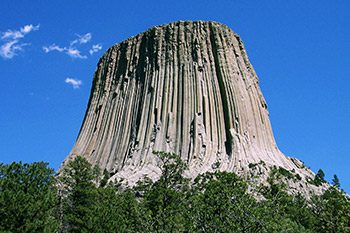
Devils Tower National Monument is an astounding geologic feature protruding out of the prairie surrounding the Black Hills. It is considered sacred by people of the Northern Plains.
Devils Tower
The Lakota were great travelers, their journeys covering much of North America. They lived by the hunt, so they followed the grazing herds of buffalo, and from early springtime to autumn they gathered fruit and edible vegetation.
According to legend, a caravan of Teton Lakota was slowly moving toward the Black Hills to harvest the many varieties of fruit abounding there. The excitement of new country, new experiences and the prospect of what lay beyond the hill held a thrill of expectation for all.
The vanguard scouts went far ahead. Their task was to blaze a trail for the others to travel, while also scouting for water facilities, hunting prospects, natural protective fortifications and good camping sites.
After many days of marching, the Lakota caravan encountered rugged terrain. To the southeast the Black Hills appeared, hazily black. Bears were numerous in the rough piney hills, but as they rarely attacked human beings unless wounded, sick or hungry. No one feared them.
Then one day, an alarm was quickly relayed through the column. Several young girls had wandered off and now were presumed to be lost. Search parties were hurriedly formed and dispatched in all directions. Finally the girls were spotted, but they were surrounded by a pack of hungry bears. The frightened children screamed for help. No one was near enough to save them. The rescuers, still too far away, looked on in horror as the growling bears closed in on the girls.
Suddenly a voice from the sky spoke to the little girls, saying pahá akíli — climb the hill. It had a strange effect on the attacking bears. For a time they stood paralyzed, giving the little girls a chance to scramble up a small hill.
The girls huddled together and hid their faces from the angry bears. Then, the earth shook and groaned as the little hill began to rise out of the ground, carrying the children high into the air. Higher and higher the mound rose, as the frustrated bears growled and clawed at its sides. Sharp pieces of rock broke away from the rising spire and crashed down upon the angry bears.
That was how Devils Tower came to be, according to Lakota legends. To prove it, the Lakota point to the deep crevices along the walls of the tower and the claw marks made by the huge bears of long ago. Devils Tower is also known as Matȟó Thípila to the Lakota (Sioux) which translates to the bears lodge.
Source: LaPointe, James. Legends of the Lakota. San Francisco: Indian Historian Press, 1976
Iktómi
The legend of Iktómi comes from the Plains, Southwestern and Western Native American groups. Iktómi has spider-like characteristics and features.
Iktómi
The legend of Iktómi (Ik-to-mi) comes from the Plains, Southwestern and Western Native American groups.
From Lakota legend, Iktómi is the firstborn son of Íŋyaŋ — the Rock — who was originally named Ksa.
Native American culture recognized Iktómi as both a spider and a spider-like man. He was born full grown from an egg and was the size of an ordinary human. He has a big round body like a spider, with slender arms and legs and powerful hands and feet. He dresses in clothes made of buckskin and raccoon.
The Lakota believe that Iktómi is a trickster and does things backwards. His clownish ways cause the people to laugh at him, but he is also a sly and cunning man and a teacher.
As a spider-like man, Iktómi the trickster possesses mysterious, supernatural powers — both good and bad. He might predict something, and if he senses that the people have doubts about his prediction, he makes it come true.
Native American culture boasts many stories about Iktómi the Trickster. In most stories, Iktómi comes out on top because he is so wise, cunning and sly. Because of these characteristics, sometimes he outsmarts himself.
Although most tales involve the trickster figure, the stories primarily center on morality lessons for the young. The tales of Iktómi’s mischief leads many to believe that he is an evil figure. However, this is not always the case. Iktómi can be seen as both good and bad, and has been portrayed in both ways. Iktómi is generally viewed as a being whose gaze is to be avoided, lest trouble find you.
Alternate names for Iktómi include Ikto, Ictinike, Inktomi, Unktome and Unktomi. These names are due to the differences in tribal languages, as this spider deity was known throughout many of North America’s tribes.
Source: Zitkála-Šá (2014). American Indian Stories and Old Indian Legends. Dover Publications Inc. p. vii.
The Great Race
The legend of the Great Race tells the story of how humans became the most powerful beings on Earth.
The Great Race
When the Great Spirit created Earth and all living things, the people and animals lived in peace and neither people nor animals ate flesh.
But, over time, the buffalo began thinking they were the most powerful beings in the world. They started to think this gave them the right to eat animals and people.
Then the people didn’t believe this was fair, as humans and buffalo were created equal. But, if that were to change, humans wanted to be the most powerful.
The buffalo said, “We should hold a contest to see whether you eat us or we eat you. How about a race?”
The people didn’t think that was a fair idea. Surely two legs couldn’t compete with four legs.
The people said, “Suppose we let the birds race for us. They have wings, you have four legs. That makes it more even.”
The buffalo agreed to these terms.
But then, some of the other animals wanted a chance to see if they could be the most powerful, too, and joined the race. All living things went to a place at the edge of the Black Hills called Buffalo Gap. There, they lined up for the race.
The buffalo chose a young female buffalo named Running Slim Buffalo Woman as their contestant. She had never been beaten in a foot race and was fiercely quick.
The humans chose four birds to race for them: a hummingbird, a meadowlark, a hawk and a magpie.
It’s been said that animals had no color in the early days of the world. But, for the race they all decided to paint themselves.
The skunk painted a white stripe on its back. The black-tailed deer painted its tail black. The antelope took some reddish-brown earth, mixed it with water and painted its whole hide.
All creatures have looked the same since the day of the Great Race.
The signal to race was given, and the crowd of runners started toward a hill, which was the halfway point.
Running Slim took off in a flash, with the buffalo cheering her on.
For a while, Hummingbird flew along with her, but soon he fell back, exhausted. Meadowlark then took over.
Still, Running Slim led the great mass of racers. Her hooves thundered as she ran. Though they had already covered a great distance, Running Slim was not showing signs of being tired.
By the time Running Slim reached the halfway point, she and Meadowlark were far ahead of the field. As the pair reached the hill, the umpires of the race shouted for them to turn back and run to the starting point, where the race would end.
Meadowlark heard these directions and knew he could not complete the race. Hawk flew in strongly to take over.
Hawk was the fastest of the birds and he shot ahead of Running Slim. The people shouted for joy … but not for long.
Hawk’s endurance did not match his swiftness, and the sudden spurt exhausted him, making room for Running Slim to take the lead again.
Then, far behind, a small speck of black and white was making its way forward, flying hard. This was Magpie. Although a slow bird, it was strong-hearted.
The buffalo herd paid no attention to Magpie; they were cheering their runner while the people watched silently.
Some of the racers were running so hard they left a blood trail. It colored the earth beneath them, which has ever remained red along the trail where the race was run.
The finish line at Buffalo Gap came into sight. Running Slim herself was beginning to slow down, though it was hardly noticeable. She was sure she would win, and didn’t even notice the tiny Magpie.
The race continued. Buffalo Gap was closer now but Running Slim could feel herself tiring. The buffalo were grunting and stomping, trying to encourage her. Magpie was still behind, but coming along steadily.
Now, Buffalo Gap was near. Tired, Running Slim gathered all her strength for the last spurt, thundering along with her heart close to bursting.
However, Magpie had come up even with her.
Both the buffalo and the people were cheering their racers on, cheering, yelling and stomping.
The two racers put the last of their strength into the race as they burst toward the finish line.
In the very small moments before Running Slim crossed the finish line, Magpie shot ahead. The people gave a great shout of happiness, and both racers fell to the ground, exhausted.
Thanks to Magpie’s determination, the humans won, and the buffalo were defeated.
Due to its determination, people have respected the Magpie since the Great Race and have never hunted it. After the completion of the Great Race, humans became the most powerful.
Source: American Indian Myths and Legends; Edited by Richard Erdoes and Alfonso Ortiz. New York: Pantheon, 1984
Sacred Ceremonies
The Seven Lakota Rites
As legend states, long ago, the Sacred White Buffalo Calf Woman came to Earth and gave the Lakota people a Sacred Pipe and a small round stone. These gifts would be used for the Seven Lakota Rites.
After presenting the gifts and teachings, the Sacred White Buffalo Calf Woman left the people saying, “There will be four ages, and I will look in on you once each age. At the end of the four ages, I will return.”
As she left, she changed from a beautiful woman into a black buffalo. Her coat then changed to red, and then to yellow, until finally changing to white. She then disappeared into the clouds.
The bowl of the pipe she gave the Lakota people was made of red stone, representing the Earth. A buffalo head was carved on the pipe, symbolizing all of the four-legged animals that roam the earth. The pipe’s stem was made of wood, representing nature. Twelve eagle feathers hung from the place where the bowl joined the stem; this symbolized all the birds.
The round stone was made out of the same red earth as the pipe and had seven circles on it, representing the seven rites.
When a Lakota person smokes a sacred pipe, his or her voice is sent to Wakȟáŋ Tȟáŋka — the Great Spirit.
Inípi
Rite of Purification
Inípi — Rite of Purification
The Lakota term for sweat lodge is Inípi, which means ‘to live again’. The Inípi serves as the basic purification ceremony of the Sioux, as well as many of the other Native American cultures. The Inípi can begin a ceremony, conclude a ceremony or can even stand alone as a ceremony of its own.
The Inípi lodge takes the shape of a dome and is constructed of 16 willow poles and a canvas or hide cover. Due to its shape, some describe the lodge as resembling the womb of Uŋčí Makȟá — Mother Earth.
Before the ceremony takes place, prayers are said and the lodge is purified.
Throughout the Inípi, participants sit on sacred sage in the shape of a circle. The ceremonial pipe is smoked while heated rocks are placed on the center fireplace and water is poured over them to create steam.
During the Inípi, the door to the lodge is opened four times to represent the four ages described by the Sacred White Buffalo Calf Woman. On the fourth time the door is opened, all participants emerge from the lodge and all that is impure stays within.
Sources: The Sacred Pipe, Black Elk’s Account of the Seven Rites of the Oglala Sioux, recorded and edited by Joseph Epes Brown. The Gift of the Sacred Pipe, Based on Black Elk’s Account of the Seven Rites of the Oglala Sioux, recorded and edited by Joseph Epes Brown. Edited and Illustrated by Vera Louise Drysdale.
Haŋbléčheyapi
Crying for a Vision
Haŋbléčheyapi — Crying for a Vision
Vision Quests can be undertaken as part of the rite of passage from boyhood to manhood or as an adult in order to receive specific revelations. Men are traditionally the ones who take part in this ceremony, but in recent years, some women have prayed for visions in formal Vision Quests.
The person participating in a Vision Quest first participates in an Inípi for purification purposes. Traditionally, the person seeking a vision builds the sweat lodge themselves.
After the Inípi ceremony, the individual seeking a revelation is isolated in a place where the power is great. Although some sites, such as the Black Hills in South Dakota, are well-known as powerful sites, all tribes have identified areas they use specifically for this purpose. The individual remains isolated at this location for several nights — usually four — fasting from food and praying for a vision that will reveal their destiny.
Visions traditionally come in the form of an animal and dreams are said to hold the most powerful visions.
After the Haŋbléčheyapi concludes, the participant’s dreams are interpreted by a Wičháša Wakȟáŋ — Holy Man.
Sources: The Sacred Pipe, Black Elk’s Account of the Seven Rites of the Oglala Sioux, recorded and edited by Joseph Epes Brown. The Gift of the Sacred Pipe, Based on Black Elk’s Account of the Seven Rites of the Oglala Sioux, recorded and edited by Joseph Epes Brown. Edited and Illustrated by Vera Louise Drysdale.
Wiwáŋyaŋg Wačhípi
Sundance
Wiwáŋyaŋg Wačhípi — Sundance
Developed by several Plains Tribes, the Sundance has been recognized by some as the most important ceremony practiced by the Lakota. The ceremony is a visual sacrifice for the people.
The annual Sundance, bringing many people from different bands together, serves as a time for renewal for the tribe, people and Uŋčí Makȟá — Mother Earth. In 1876, one of the largest Sundance ceremonies took place near the Little Big Horn River, bringing approximately 6,000 participants together.
Individuals vow to participate in the Sundance in return for a specific form of help — such as sparing the life of a sick relative, finding buffalo during times they were scarce or experiencing success during war.
Participation in a Sundance includes the dancer’s entire family. Throughout the ceremony, family members offer assistance and encouragement to their loved one.
The ceremony, traditionally lasting seven days, begins with the cutting of the Sundance pole, preferably cut from a cottonwood tree, which is not allowed to touch the ground as it falls. The pole is decorated and placed in the middle of the arena.
At the beginning of the ceremony, anyone can dance. Dancers make sure to face the sun and take this time — usually four days — to prepare themselves.
The heart of the ceremony is the piercing of the Sundancers’ pectoral or back muscles with a length of bone. The bone is then attached to the pole or buffalo skulls by rope. The purpose of the dance is to remove the pieces of bone from one’s body. Those attached to the pole leaned backwards to try and release themselves. Those attached to skulls drag them over rocks and through bushes to encourage the bones to break free.
Sources: The Sacred Pipe, Black Elk’s Account of the Seven Rites of the Oglala Sioux, recorded and edited by Joseph Epes Brown. The Gift of the Sacred Pipe, Based on Black Elk’s Account of the Seven Rites of the Oglala Sioux, recorded and edited by Joseph Epes Brown. Edited and Illustrated by Vera Louise Drysdale.
Huŋkálowaŋpi
Making of Relatives
Huŋkálowaŋpi — Making of Relatives
The Huŋkálowaŋpi ceremony was first used to build peace between the Lakota and Ree people. This ceremony ensured peace and friendship between the tribes and mirrored the relationship of the Lakota with Wakȟáŋ Tȟáŋka — the Great Spirit.

Today, the ceremony traditionally includes an older man taking a younger man under his wing, offering to protect and treat the young man as his own son. Occasionally, the ceremony also serves as a way of adopting nontribal members into a family.
Today, one can become part of a thiyóšpaye — extended family — by birth, marriage or Huŋkálowaŋpi.
Sources: The Sacred Pipe, Black Elk’s Account of the Seven Rites of the Oglala Sioux, recorded and edited by Joseph Epes Brown. The Gift of the Sacred Pipe, Based on Black Elk’s Account of the Seven Rites of the Oglala Sioux, recorded and edited by Joseph Epes Brown. Edited and Illustrated by Vera Louise Drysdale.
Išnáthi Awíčhalowaŋpi
A Girl’s Coming of Age
Išnáthi Awíčhalowaŋpi — A Girl’s Coming of Age
This rite was performed at the time when a young girl realized the change taking place in her life was a sacred thing. The ceremony was held to purify and prepare her for becoming a woman and bearing children. Although the Išnáthi Awíčhalowaŋpi ceremony is not as common today due to the changes in gender expectations, the ceremony traditionally occurs during a girl’s first menstrual cycle.
Family members build a tipi and gather the necessary objects for the ceremony. On the day of the ceremony, a Wičháša Wakȟáŋ — Holy Man — burns sweet grass and uses the smoke to purify all of the ceremonial objects. A feast was held, and a giveaway took place. The goodness and holiness that came to the young girl also then extended to the whole tribe.
Overall, the young girl is reminded of the virtues necessary for womanhood, including modesty, generosity, child bearing and supporting male relatives and husbands.
Sources: The Sacred Pipe, Black Elk’s Account of the Seven Rites of the Oglala Sioux, recorded and edited by Joseph Epes Brown. The Gift of the Sacred Pipe, Based on Black Elk’s Account of the Seven Rites of the Oglala Sioux, recorded and edited by Joseph Epes Brown. Edited and Illustrated by Vera Louise Drysdale.
Wanáǧi Yuhápi
Keeping of the Soul
Wanáǧi Yuhápi — Keeping of the Soul
According to the Sacred White Buffalo Woman, when a Lakota person dies, their souls must be purified so they can reunite with Wakȟáŋ Tȟáŋka — Great Spirit.
Traditionally, a lock of hair from the departed was cut and held over a piece of burning sweet grass for purification purposes. After being wrapped in a piece of sacred buckskin, called the soul bundle, the bundle was kept by the soul’s keeper in a special place within the tipi. The Keeper of the Soul vowed to live a life of harmony until the soul can be released — typically about a year.
After a commemorative banquet and gift-giving ceremony, the bundle containing the soul was carried outside and released.
It is said that the soul travels along the Spirit Path — Milky Way — to reach Mayá Owíčhapaha — the old woman who judges each soul.
The one-year commemoration remains a common ceremony today.
Sources: The Sacred Pipe, Black Elk’s Account of the Seven Rites of the Oglala Sioux, recorded and edited by Joseph Epes Brown. The Gift of the Sacred Pipe, Based on Black Elk’s Account of the Seven Rites of the Oglala Sioux, recorded and edited by Joseph Epes Brown. Edited and Illustrated by Vera Louise Drysdale.
Tȟápa Waŋkáyeyapi
Throwing of the Ball
Tȟápa Waŋkáyeyapi — Throwing of the Ball
In a ceremony preceding the Tȟápa Waŋkáyeyapi ceremony, a ball is painted red, with a blue dot in each of the four quarters. Two circles blue in color were painted around the ball, which symbolize heaven and earth coming together. A pipe was purified with sweet grass smoke while prayers were sent to Wakȟáŋ Tȟáŋka — the Great Spirit and the powers of the Four Directions. The ball was said to have been given to man by the buffalo, symbolizing that man was the inheritor of the earth.
A young girl is traditionally chosen to throw the ball. After reaching the center of a large circle, she throws the ball to each of the Four Directions. People standing around the circle catch the ball and return it to her. After throwing to the West, South, East and North, the girl throws the ball high into the air. As the ball comes down on the people, the Great Spirit’s power also comes down.
Sometimes used as a healing ceremony for a stressed community, Tȟápa Waŋkáyeyapi highlights that Wakȟáŋ Tȟáŋka — the Great Spirit — is everywhere.
Sources: The Sacred Pipe, Black Elk’s Account of the Seven Rites of the Oglala Sioux, recorded and edited by Joseph Epes Brown. The Gift of the Sacred Pipe, Based on Black Elk’s Account of the Seven Rites of the Oglala Sioux, recorded and edited by Joseph Epes Brown. Edited and Illustrated by Vera Louise Drysdale.